In oil and gas operations, efficiency and uptime are everything. Whether it’s heating, treating, or separating process streams, facilities rely on equipment that performs reliably under demanding conditions—and that can be deployed quickly with minimal on-site fabrication.
What Is a Skid-Mounted Process System?
- Heater assemblies (direct-fired or indirect-fired)
- Burner management systems and controls
- Fuel gas conditioning
- Separation or dehydration equipment
- Instrumentation and safety devices
Why Skid-Mounted Systems Are Changing the Game
1. Faster Installation and Startup
- Placement on a foundation or support structure
- Utility hookups (fuel, power, process lines)
- Control system integration
2. Improved Quality and Reliability
Building a process system in a controlled environment ensures higher quality and consistency than field construction. Skilled technicians and fabricators can follow precise design specifications, and quality assurance checks can be performed throughout the build process.
This off-site approach minimizes common field errors—such as misaligned piping, incorrect welds, or faulty wiring—that can cause costly delays or performance issues down the road.
3. Enhanced Safety and Reduced Site Risk
Construction and installation activities on active sites introduce inherent safety risks—from hot work and elevated tasks to vehicle and equipment movement. By shifting assembly and testing to a controlled fabrication environment, skid-mounted systems significantly reduce on-site exposure.
4. Compact, Space-Efficient Design
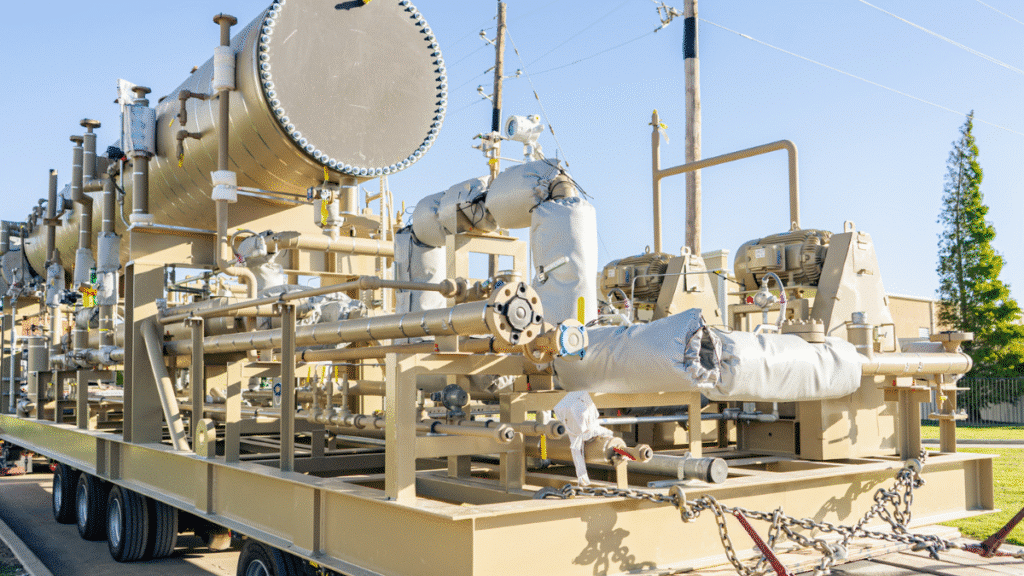
Real estate on a processing site is limited—and costly. Skid-mounted designs maximize the use of space by integrating all components into a compact, modular footprint.
Because everything is pre-arranged for functionality and maintenance access, operators can avoid the inefficiencies of scattered or oversized layouts. The modular design also allows for easier system scaling: additional skids can be added as capacity requirements grow without redesigning the entire process area.
5. Simplified Maintenance and Mobility
Maintenance access is often a challenge in large, fixed installations. Skid-mounted systems solve this problem with intentionally organized layouts that prioritize accessibility.
6. Cost Efficiency Over the System Lifecycle
- Reduced field labor and construction costs
- Lower startup and commissioning expenses
- Minimized downtime during installation and maintenance
- Extended equipment life through process modeling and optimization of fabrication and quality control
Applications in Process Heating and Treatment
- Heater treaters for oil-water separation
- Glycol dehydration systems for gas drying
- Solid desiccant dehydration systems for low-temperature operations
- Water bath and direct-fired heaters for process heating
- Fuel gas conditioning systems
Customization and System Design
One of the most significant advantages of skid-mounted systems is customization. While these systems are modular, they are not “one-size-fits-all.” Each unit is designed to meet the unique requirements of the facility and process—whether that involves specific flow rates, gas compositions, space constraints, or environmental conditions.
The Future of Modular Process Systems
Conclusion
Ready to get started with Total Product Services?